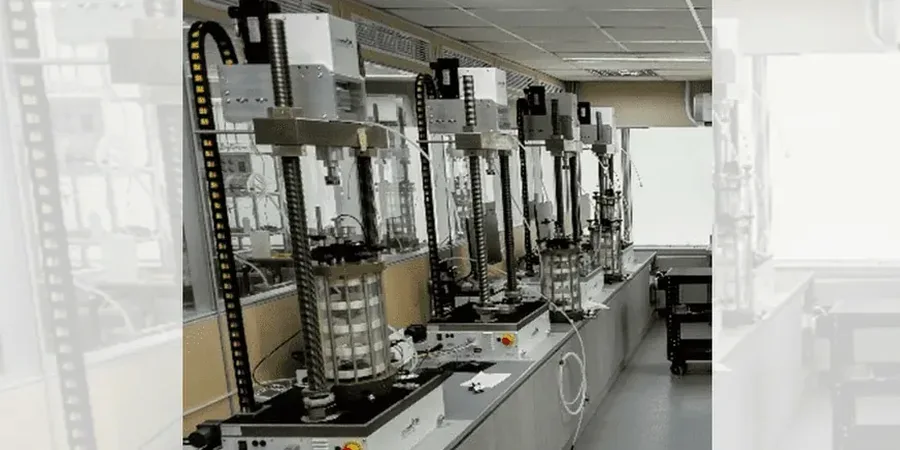
A 10-story mixed-use development off Hillsborough Street ran into a problem during excavation. The Piedmont residual soils at depth exhibited unexpected cohesion values that the standard penetration tests hadn’t fully captured. The structural engineer on record needed drained friction angles and undrained shear strength with a higher degree of certainty before signing off on the mat foundation design. That’s where a consolidated-undrained triaxial test with pore pressure measurement becomes non-negotiable. In Raleigh’s transition zone between the Triassic basin saprolite and younger alluvium near Walnut Creek, soil behavior can shift dramatically within a single boring. A CPT test helps map the stratigraphic boundaries, but only a triaxial compression test can deliver the effective stress parameters that modern limit state design demands under ASCE 7 and IBC provisions. Our laboratory processes undisturbed Shelby tube samples from sites across Wake County, applying multi-stage loading to replicate the stress path that a foundation imposes on the subgrade. We routinely test samples from depths exceeding 60 feet where confining pressures approach 3 ksf, conditions common in downtown Raleigh’s deeper foundation elements.
Triaxial testing on Piedmont residual soils reveals effective friction angles that standard SPT correlations can underestimate by 15 to 20 percent.
Process and scope
Site-specific factors
A common mistake we see in Raleigh projects is relying on unconfined compression tests for fine-grained Piedmont soils that contain silt partings or fissures. When a contractor on a South Saunders Street site used UCS data to justify a 4,000 psf bearing pressure for spread footings, the excavation revealed slickensided clay seams that reduced the operational shear strength by nearly half. The project required a costly redesign to a deep foundation system with piles socketed into weathered rock. Triaxial testing with pore pressure measurement would have identified the contractant behavior of the fissured clay during shearing. In saturated zones near the Neuse River floodplain, undrained loading during rapid construction can generate excess pore pressures that a drained direct shear test would never capture. The consolidated-undrained test with pore pressure measurement gives the engineer both total and effective stress parameters from a single specimen, providing the data needed to assess both short-term stability during excavation and long-term settlement under permanent loads. Without this level of testing, foundation designs in Raleigh’s complex residual soil profile carry an uncertainty that no factor of safety can fully address.
Reference standards
ASTM D4767-11: Standard Test Method for Consolidated Undrained Triaxial Compression Test for Cohesive Soils, ASTM D2850-15: Standard Test Method for Unconsolidated-Undrained Triaxial Compression Test on Cohesive Soils, ASTM D7181-20: Standard Test Method for Consolidated Drained Triaxial Compression Test for Soils, ASCE 7-22: Minimum Design Loads and Associated Criteria for Buildings and Other Structures, IBC 2021: Chapter 18 Soils and Foundations
Complementary services
Consolidated-Undrained (CU) with Pore Pressure
The standard for evaluating effective stress strength parameters in saturated cohesive soils beneath Raleigh foundations. Specimens are saturated using back pressure, consolidated to in-situ stress, then sheared undrained while recording excess pore pressure. Results yield c’ and φ’ for long-term stability analysis of slopes and retaining structures.
Unconsolidated-Undrained (UU) Quick Triaxial
Applied for short-term bearing capacity checks on fine-grained fill and natural clays during construction. Specimens are sheared without consolidation, providing the undrained shear strength Su used in total stress analysis. Common for temporary excavation support design and embankment stability during staged construction in the Raleigh area.
Typical parameters
Common questions
What is the cost range for a triaxial test program in Raleigh?
A standard triaxial testing program with three CU specimens at different confining pressures typically runs between US$2,140 and US$2,330. The exact cost depends on the number of specimens, test type (UU, CU, or CD), and whether multi-stage loading reduces the sample count. We provide a fixed-price proposal after reviewing the boring logs and project requirements.
How long does it take to get triaxial test results?
A CU triaxial test with pore pressure measurement typically requires 10 to 14 working days from sample receipt. The consolidation phase alone can take 24 to 48 hours for low-permeability Piedmont clays. We expedite reporting for critical path items when discussed in advance.
What sample quality is required for reliable triaxial testing?
We require undisturbed Shelby tube samples with a recovery ratio above 85% and no visible disturbance. Samples should be sealed with wax immediately after extrusion in the field and transported in cushioned carriers. Disturbed samples or those with drying cracks will not yield representative strength parameters.
Which triaxial test type is appropriate for Raleigh residual soils?
For saturated fine-grained residual soils derived from the Raleigh Belt gneiss, a consolidated-undrained test with pore pressure measurement (ASTM D4767) is most appropriate. For partially saturated compacted fill, an unconsolidated-undrained test (ASTM D2850) provides conservative short-term parameters. Our lab director reviews the specific moisture condition and project loading scenario before recommending the test protocol.
How are the confining pressures selected for a triaxial test program?
Confining pressures are selected to bracket the in-situ effective stress at the sample depth. For a sample from 30 feet below grade in Raleigh, the effective vertical stress is approximately 1.5 to 2.0 ksf, so we typically run specimens at 1, 2, and 4 ksf confining pressure. The range is adjusted based on the proposed foundation load and the depth of the failure surface being analyzed.