The difference between a pavement that lasts 20 years and one that fails in five often comes down to a number few people see: the soaked CBR. Raleigh's geology tells a story of two cities. Head down to the Crabtree Creek floodplain and you will find fat clays and silts that turn to soup after a storm. Move west toward the airport and you hit residual soils from weathered felsic gneiss—sandy silts that look solid in dry weather but lose significant strength when saturated. Our grain-size analysis frequently confirms this variability across the same project site. The laboratory CBR test gives us the quantitative basis to write pavement specifications that actually match what is under the asphalt. A value of 3% versus 8% changes the entire structural section. No guesswork. Just repeatable data under controlled moisture and density conditions, compacted to a target energy level and soaked for 96 hours to simulate the worst-case scenario under Raleigh's water table fluctuations.
A soaked CBR value of 3% demands a fundamentally different pavement structure than an 8% value. You cannot fix that difference with an extra inch of asphalt.
Process and scope
Site-specific factors
Raleigh's explosive growth since the 1990s has pushed development into areas that older engineers knew to avoid. The Falls Lake watershed expansion and the relentless subdivision of former agricultural land north of 540 placed thousands of homes on soils with marginal bearing capacity. When the Research Triangle Park boom accelerated in the 2000s, the pressure to pave access roads quickly led to some spectacular subgrade failures. The laboratory CBR test became a non-negotiable checkpoint for NCDOT projects after several high-profile pavement failures on secondary roads in Wake County. The risk today is the same as it was then: designing a pavement cross-section on assumptions rather than measurements. A design CBR of 10% when the actual soaked value is 4% results in a structural number deficit that manifests as rutting, fatigue cracking, and base course contamination within three to five years. The cost of reconstruction dwarfs the cost of proper laboratory testing by a factor of ten or more. In the Piedmont residual soils that dominate Raleigh's geology, the difference between the dry CBR and the soaked CBR can be a factor of three. Skipping the soak is not a cost-saving measure. It is a design failure waiting to happen.
Reference standards
ASTM D1883: Standard Test Method for California Bearing Ratio (CBR) of Laboratory-Compacted Soils, AASHTO T 193: The California Bearing Ratio, ASTM D1557: Standard Test Methods for Laboratory Compaction Characteristics of Soil Using Modified Effort, NCDOT Standard Specifications for Roads and Structures, Section 500, ASCE 7-22 Minimum Design Loads and Associated Criteria
Complementary services
Soaked Laboratory CBR (ASTM D1883)
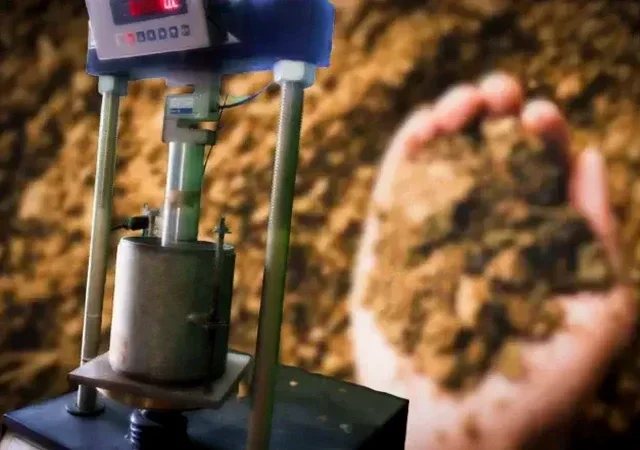
Three-point compaction curve with CBR specimens compacted at optimum moisture content and soaked for 96 hours under a 10-lb surcharge. Penetration testing at 0.05 in/min with continuous load-displacement recording. We report the corrected CBR at 0.1 and 0.2 inches of penetration, with stress-penetration curves for each specimen.
Modified Proctor Compaction (ASTM D1557)
Determination of the maximum dry density and optimum moisture content using the 10-lb hammer and 18-inch drop. This is the prerequisite test for all laboratory CBR work. We run the full five-point curve, not a reduced set, to ensure the compaction target is accurate for Raleigh's variable soils.
Pavement Design Support Package
Integration of soaked CBR results with traffic loading data to develop pavement structural numbers. We provide the design CBR value, resilient modulus correlation (Mᵣ = 2555 × CBR⁰·⁶⁴), and recommended layer thicknesses for flexible and rigid pavement options per AASHTO 1993 guidelines and NCDOT requirements.
Typical parameters
Common questions
What is the difference between field CBR and laboratory CBR, and why does NCDOT require lab testing?
Field CBR is performed on in-place soil at its natural moisture content and density, which varies with weather and season. Laboratory CBR is performed on specimens compacted to a specified density at optimum moisture content and then soaked for 96 hours to simulate long-term saturation. NCDOT requires laboratory CBR because it provides a worst-case, reproducible value that can be used for pavement design with confidence. A field CBR taken in August might be 15% while the soaked laboratory value on the same soil is 4%. The pavement must be designed for the 4% condition.
How much does a laboratory CBR test cost in Raleigh?
For Raleigh-area projects, a standard soaked laboratory CBR test—including the three-point Modified Proctor compaction curve, specimen preparation at optimum moisture, 96-hour soaking, and penetration testing—typically ranges from US$130 to US$200 per sample, depending on the number of specimens and the reporting requirements. This does not include soil classification tests such as grain-size analysis or Atterberg limits, which are often run in parallel.
How long does the testing take from sample receipt to report delivery?
Plan for a minimum of seven working days. The compaction test requires one day for specimen preparation and drying. The CBR specimens must be compacted and then soaked for a full 96 hours (four days) per ASTM D1883. Penetration testing and data reduction take one additional day. For projects with tight schedules, we can run multiple samples in parallel to reduce calendar time, but the 96-hour soaking period is a hard requirement that cannot be shortened.
What CBR values are typical for the soils in the Raleigh area?
Raleigh sits in the Piedmont physiographic province, where residual soils derived from weathered felsic gneiss and schist dominate. Typical soaked CBR values range from 3% for fat clays in the Triassic basin deposits near Crabtree Creek to 12-15% for well-graded sandy silts in the higher elevations west of the city. Most sites fall between 5% and 8%. Soils with a soaked CBR below 5% generally require chemical stabilization or a substantially thicker aggregate base to meet NCDOT structural requirements.