Raleigh sits on the Fall Line, the geologic boundary between the hard crystalline rock of the Piedmont and the looser sediments of the Coastal Plain. This transition creates wildly variable soil conditions across the city. A site off Glenwood Avenue might hit weathered gneiss at 3 feet, while a lot near Crabtree Creek encounters fat clays down to 30 feet. The IBC and ASCE 7 both point back to soil classification as the starting point for seismic site class and bearing capacity. Without reliable grain-size data and Atterberg limits, you cannot assign a proper Group Symbol under ASTM D2487. The lab team runs liquid limit and plastic limit on every project using ASTM D4318 method A or B, depending on whether the material passes the 425-micron sieve. Plasticity index from Atterberg limits feeds directly into correlations for undrained shear strength and compression index, so skipping this step means guessing on settlement calculations.
Three numbers – liquid limit, plastic limit, and plasticity index – separate a low-risk sandy silt from a high-risk fat clay. In Raleigh, that distinction determines whether your foundation needs a moisture barrier or just standard reinforcement.
Process and scope
Site-specific factors
Raleigh's explosive growth since the 1990s pushed development into areas that earlier builders avoided. Falls Lake and its tributary floodplains, the Triassic basin clays east of downtown, and infill lots across older neighborhoods all present soils where plasticity controls performance. The 2014 update to the North Carolina Building Code strengthened foundation inspection requirements after several slab-on-grade failures in Wake County were traced to unclassified expansive clays. An Atterberg limits test costs a fraction of a foundation repair, and the results feed directly into IBC Table 1806.2 for presumptive bearing values. For pavement subgrades, NCDOT Standard Specifications Section 1016 references AASHTO T89 and T90, which mirror ASTM D4318 procedures. If the plasticity index exceeds 15, lime stabilization often becomes the most economical option, and we can run the limits again post-treatment to confirm the mix design worked.
Reference standards
ASTM D4318 – Standard Test Methods for Liquid Limit, Plastic Limit, and Plasticity Index of Soils, ASTM D2487 – Standard Practice for Classification of Soils for Engineering Purposes (Unified Soil Classification System), ASTM D2216 – Standard Test Methods for Laboratory Determination of Water (Moisture) Content of Soil and Rock by Mass, AASHTO T89/T90 – Determining the Liquid Limit and Plastic Limit of Soils, IBC Chapter 18 – Soils and Foundations
Complementary services
Atterberg Limits + Sieve Analysis Package
Combined hydrometer and sieve analysis per ASTM D422 paired with liquid and plastic limits. Delivers full USCS classification (ASTM D2487) with the plasticity chart plotted. Typical turnaround: 5 business days.
Foundation Soil Screening Suite
Atterberg limits, moisture content, and organic content (loss on ignition) for shallow foundation design. Recommended for slab-on-grade projects in Wake County's expansive soil zones. Includes a brief interpretive memo with PI-based swell potential rating.
Typical parameters
Common questions
How much does Atterberg limits testing cost per sample?
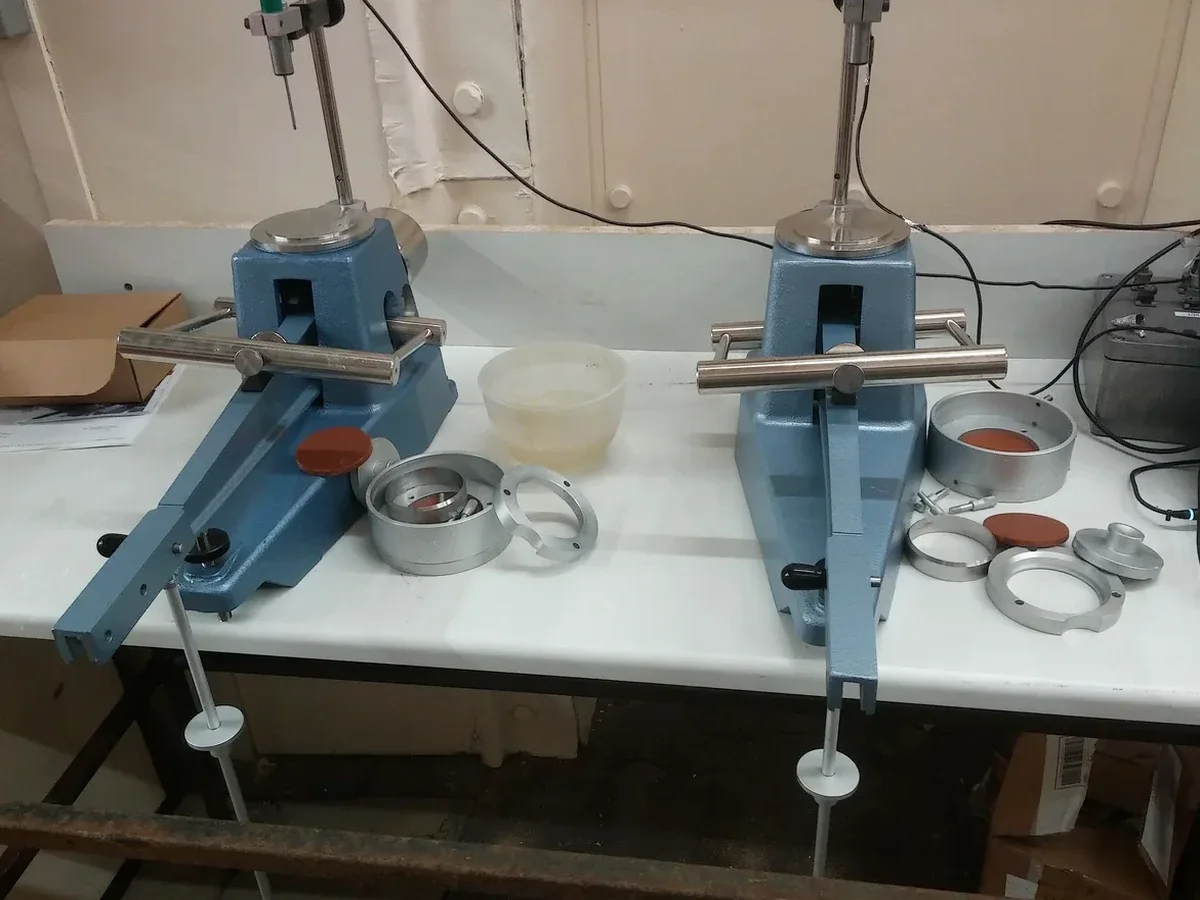
Standard Atterberg limits testing (liquid limit and plastic limit) runs between US$60 and US$100 per sample depending on whether you need the Casagrande cup method, the fall-cone method, or both. Rush processing adds a surcharge. If you bundle it with a sieve analysis or moisture content determination, the per-test rate drops. We can provide a firm quote once we know the number of samples and the turnaround you need.
How much soil do you need for the test?
We ask for at least 150 grams of material passing the No. 40 (425-micron) sieve. If the sample contains coarse particles, send a larger bag – about 500 grams – so we can sieve it in-house and still have enough fines for the Atterberg limits. The soil should be in a sealed plastic bag to preserve its natural moisture content.
Do you test the sample as-received or dried?
ASTM D4318 requires the multipoint liquid limit method to start from the natural moisture condition (wet preparation). We follow that unless the project specification asks for dry preparation. The plastic limit is always run on material that has been dried and re-mixed with distilled water to achieve the crumbling condition at a 3 mm thread.
Why do Raleigh projects need Atterberg limits if we already have SPT blow counts?
SPT N-values tell you relative density or consistency, but they do not classify the soil. A silty sand and a lean clay can both give N=12, yet their drainage, strength, and volume-change behavior are completely different. Atterberg limits fill that gap by quantifying the plasticity of the fines fraction. For seismic site class determination per ASCE 7, you need both – the blow counts and the soil's PI to check against Site Class E thresholds for soft clays.