Raleigh sits at 434 feet above sea level on the Piedmont Plateau, where the transition from sound rock to deep saprolite creates unpredictable bearing conditions. We routinely encounter soft alluvial pockets along Crabtree Creek and Neuse River tributaries that cannot support shallow footings without ground improvement. Stone column design solves this by installing dense granular columns that reinforce the weak matrix through lateral confinement and drainage. The design must account for the stiff residual soil crust typical of Wake County—ignoring that upper layer leads to overestimated settlements. Our lab validates the aggregate gradation and fines content before any installation begins. For deeper site characterization we combine the CPT test to profile the soft zones continuously, and the grain-size analysis to confirm compatibility between native soil and backfill material.
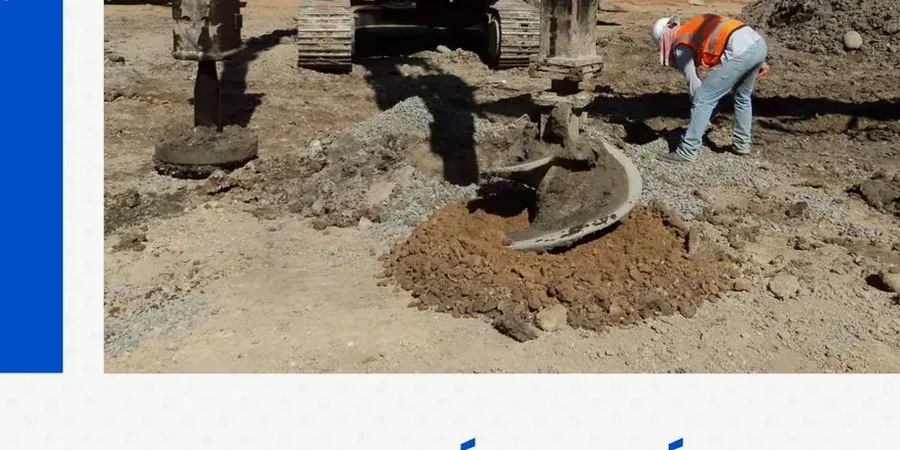
A stone column grid triples the stiffness of soft Raleigh alluvium while cutting primary settlement time by 70% through radial drainage.
Process and scope
Site-specific factors
The most common error we see is a contractor placing stone columns based on a uniform grid without verifying the lateral extent of the soft zone. In Raleigh, the saprolite boundary can dip sharply over just 50 feet, leaving outer columns partially bearing on competent material while interior columns float in soft clay. The result is differential settlement that cracks slabs and breaks utility lines within the first year. Another failure mode is aggregate contamination—using crusher run with excess fines clogs the drainage function and reduces friction angle below the design value of 38 to 42 degrees. We require grain-size testing on every 500 tons delivered and a minimum of two modulus verification tests per critical structural zone. The IBC 2021 references ASCE 7-22 for ground improvement quality assurance, and we follow that protocol without exception.
Reference standards
IBC 2021 – Chapter 18: Soils and Foundations, ASCE 7-22 – Ground improvement QA/QC requirements, ASTM D2487 – Unified Soil Classification System (USCS), ASTM D1586 – Standard Penetration Test (SPT)
Complementary services
Stone Column Design Report
Complete design package with column layout, area replacement ratio calculations, settlement and bearing capacity analysis using Priebe or FE methods, aggregate specification, and QA/QC testing schedule per ASCE 7-22.
Modulus Verification Testing
Post-installation plate load testing on individual stone columns and column groups to confirm design stiffness. Includes load-settlement curves, modulus back-calculation, and compliance letter for the building official.
Typical parameters
Common questions
What soil types in Raleigh benefit most from stone columns?
Soft alluvial clays and loose silty sands along the Neuse River floodplain and Crabtree Creek corridor. These deposits often have SPT N-values below 6 and undrained shear strengths under 500 psf—conditions where stone columns provide both reinforcement and accelerated drainage during consolidation.
How much does a stone column design package cost in Raleigh?
A complete design report including settlement and bearing analysis, aggregate specification, and QA/QC plan typically ranges from US$1,500 to US$5,850 depending on the treated area and number of column verification tests required.
How do you verify the stone columns work as designed?
We run plate load tests on isolated columns and column groups using a reaction frame or kentledge. The measured modulus must meet or exceed the design value. We also test aggregate gradation and fines content at the plant and on site at 500-ton intervals.
What is the minimum depth for stone columns in the Piedmont?
Columns must penetrate the full thickness of the soft layer and bear on competent residual soil or rock. In Raleigh that typically means depths between 15 and 45 feet. We confirm the bearing stratum with CPT or SPT refusal data before finalizing the column length.