A project off Capital Boulevard hit weathered rock at 4 feet on one corner and 18 feet on another—same half-acre lot. This isn't unusual in Raleigh, where the Piedmont geology transitions from deep saprolite to shallow gneiss across short distances. A properly scoped soil mechanics study captures that variability before the excavator breaks ground. We analyze particle-size distribution, Atterberg limits, and shear strength to calculate bearing pressure that works with the actual stratum, not against it. When the subsurface includes Triassic mudstone, as it does through much of east Raleigh, expansive clay behavior becomes a design parameter that a CPT test can profile continuously without disturbing the sample structure. The geotechnical report becomes your contract with reality—specifying foundation type, reinforcement, and drainage based on lab-validated data, not assumptions from a county soil survey.
Raleigh's residual soils can lose 60% of their undisturbed strength when remolded—lab testing must preserve in-situ structure to give usable design numbers.
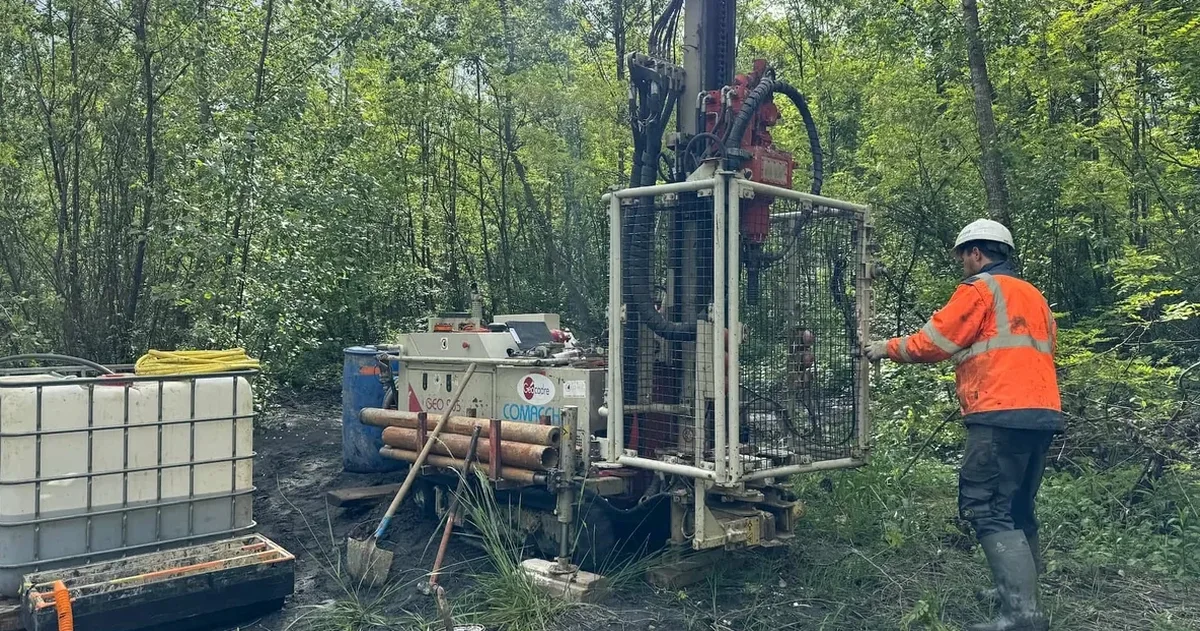
Process and scope
Site-specific factors
North Raleigh near Falls Lake sits on deep saprolitic soils that drain well but can compress unevenly under load—differential settlement of 1 inch in 20 feet isn't hypothetical here. Compare that to downtown Raleigh, where the contact between Triassic sedimentary rock and the Rolesville Granite pluton creates abrupt transitions that fool a standard boring log into assuming uniform conditions. A soil mechanics study that ignores this geologic boundary risks specifying a foundation system that performs on one side of the building but not the other. Add the fact that seismic demand in Wake County—while moderate by West Coast standards—still requires Site Class determination per ASCE 7-22 Chapter 20, and the consequence of skipping a full laboratory program is a design that may not even satisfy the minimum code check for bearing capacity under seismic load combinations.
Reference standards
ASCE 7-22 (Minimum Design Loads), IBC 2024 / North Carolina Building Code, ASTM D2487 (Unified Soil Classification), ASTM D2850 (UU Triaxial), ASTM D4318 (Atterberg Limits), ASTM D1586 (Standard Penetration Test)
Complementary services
Foundation Design Parameter Report
Delivers allowable bearing capacity, modulus of subgrade reaction, and estimated total/differential settlement for shallow footings or mat foundations. Includes shrink-swell classification per ASTM D4829 for sites in the Triassic basin.
Slope Stability and Retaining Wall Analysis
Effective stress analysis for cut slopes exceeding 8 feet, with groundwater modeling based on seasonal piezometer readings. Wall backfill recommendations account for the low permeability of Raleigh's saprolitic silts.
Seismic Site Classification
Shear wave velocity (Vs30) determination using downhole seismic or MASW, processed to assign Site Class per ASCE 7-22 Table 20.3-1. Required for Risk Category III and IV structures in Wake County.
Typical parameters
Common questions
How much does a soil mechanics study cost for a single-family home lot in Raleigh?
For a typical residential lot under half an acre inside the I-440 beltline, the investigation—including two borings to 25 feet, lab classification, and a sealed report with bearing capacity—runs between US$2,980 and US$4,930. The range moves up when the scope requires deeper rock coring, triaxial shear testing, or a seismic site class determination. Commercial projects with multiple borings and more extensive lab programs are quoted on a site-specific basis after we review the grading plan.
What depth of exploration does the City of Raleigh require?
Raleigh’s Development Services follows IBC Section 1803, which requires borings to extend through all unsuitable strata—organic material, fill, undocumented backfill—and into competent bearing material. In practical terms for the Piedmont, that means a minimum of 20 feet below finished grade for shallow foundations, or deeper when the boring encounters saprolite with SPT N-values below 15 within that zone. For deep foundations, borings must penetrate at least 10 feet below the estimated pile tip elevation.
Does the report address expansive clay risk in Raleigh's Triassic basin?
Yes. Any soil mechanics study performed on a site mapped within the Durham Triassic basin—roughly east of Downtown Boulevard—includes Atterberg limits, percent passing #200, and expansion index testing. The report explicitly states the foundation design measures needed, such as under-slab moisture barriers, deepened perimeter footings, or lime treatment of subgrade, to mitigate heave potential that can exceed 2 inches of vertical movement in high-plasticity zones.
How long does it take to receive the final geotechnical report?
Fieldwork—drilling, sampling, and logging—typically takes one to two days for a standard residential or light commercial site. Laboratory testing runs 7 to 10 business days, depending on whether consolidation or triaxial tests are required. The final report, sealed by a North Carolina-licensed professional engineer, is delivered 10 to 14 business days after the field crew demobilizes. Rush turnaround is available for projects facing permit deadlines.
Can the soil mechanics study be used for both the building permit and the stormwater permit?
Partially. The geotechnical report satisfies the structural plan review requirements for foundation design, but Raleigh's Stormwater Management Division typically requires a separate infiltration test report—such as a double-ring infiltrometer or a falling-head borehole test—for BMP sizing. We can add that testing scope to the same field mobilization so you aren't scheduling two separate site visits, and the soil classification data from the mechanics study supports the infiltration analysis.