Raleigh's subsurface tells two very different stories, and the contrast between the weathered granitic saprolite near Umstead State Park and the deep alluvial clays of the Crabtree Creek floodplain shapes every tunneling decision in the city. Saprolite retains relict rock structure but crumbles under saturated conditions, while the floodplain deposits, rich in organic silts with SPT blow counts often below 4, deform plastically the moment confinement shifts. A standard site investigation misses this transition unless the boring program targets the Piedmont's irregular bedrock profile, where competent gneiss can plunge from 15 to over 80 feet within a single city block. The geotechnical analysis for soft soil tunnels in Raleigh bridges that gap by mapping the saprolite-to-alluvium interface and quantifying the time-dependent settlement that soft ground inevitably triggers. Understanding how these two soil regimes behave under a tunnel face is not just academic; it is the difference between a controlled drive and a surface depression that reaches the Beltline shoulder.
Saprolite in Raleigh's Piedmont can lose 60% of its unconfined compressive strength within 48 hours of moisture exposure, a decay rate that directly determines tunnel face stand-up time.
Process and scope
Site-specific factors
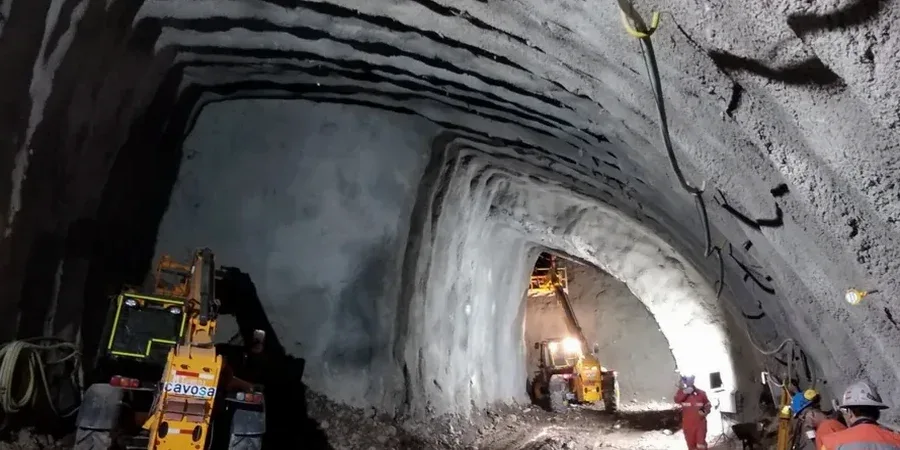
The EPB tunnel boring machine's cutterhead torque spikes when it encounters the transition from soft alluvium into competent Raleigh gneiss, a contact that the Piedmont's undulating paleotopography places unpredictably close to the tunnel crown. Crews monitoring the platen pressure in real time see numbers jump from a steady 1.8 bar in the clay to over 4.5 bar when the face becomes mixed, and if the conditioning foam ratio was designed for homogeneous ground, the chamber can clog within minutes. That rapid pressure fluctuation transmits to the surface as differential settlement before the tail void grouting has set, threatening shallow utilities along Glenwood Avenue or stormwater culverts that feed into House Creek. A proper geotechnical analysis for soft soil tunnels in Raleigh pre-locates these mixed-face intervals by correlating seismic refraction lines with continuous SPT logs, so the TBM operator can adjust face pressure and foam injection parameters before the torque alarm sounds. Neglecting that step shifts the cost from investigation to emergency grouting and road closure.
Reference standards
ASTM D1586 Standard Test Method for Standard Penetration Test (SPT) and Split-Barrel Sampling of Soils, ASTM D2487 Standard Practice for Classification of Soils for Engineering Purposes (Unified Soil Classification System), ASCE 7-22 Minimum Design Loads and Associated Criteria for Buildings and Other Structures, IBC Chapter 18 Soils and Foundations (North Carolina Building Code Council adoption), ASTM D4767 Standard Test Method for Consolidated Undrained Triaxial Compression Test for Cohesive Soils, ASTM D4644 Standard Test Method for Slake Durability of Shales and Similar Weak Rocks
Complementary services
Soft Ground TBM Parameter Definition
We establish the undrained shear strength profile, effective stress envelope, and K0 values required to set EPB face pressure, foam injection ratio, and tail void grouting pressure. The output feeds directly into Plaxis or FLAC3D models used by the tunnel designer.
Settlement Risk Assessment along Tunnel Alignment
Using Peck-Fujita empirical curves calibrated to Raleigh's saprolitic and alluvial soils, we predict transverse settlement troughs and angular distortion at critical crossings, including sanitary sewer lines and NCDOT right-of-way.
Mixed-Face Transition Zoning
We map the soil-rock interface ahead of the tunnel face by combining SPT refusal depths with seismic refraction P-wave velocities, identifying the exact chainages where the cutterhead will encounter mixed ground and require conditioning adjustments.
Typical parameters
Common questions
How much does a geotechnical analysis for a soft soil tunnel in Raleigh typically cost?
The cost ranges from approximately US$4,420 for a limited investigation over a short alignment to US$14,940 for a comprehensive program that includes deep borings, multiple CU triaxial tests, slake durability analysis, and settlement prediction modeling. The final figure depends on the number of boreholes, the depth of the tunnel horizon, and the laboratory testing required to characterize the saprolite-to-alluvium transition. We provide a fixed-scope proposal after reviewing the preliminary tunnel geometry and alignment.
Why is Raleigh's saprolite so problematic for tunneling?
Saprolite in the Raleigh Piedmont is a product of in-situ chemical weathering of granitic gneiss, retaining the parent rock's texture but none of its strength. It stands up briefly when excavated, then slakes rapidly upon moisture absorption. This time-dependent degradation means a tunnel face that appears stable during inspection can ravel within hours, especially if the TBM stops for maintenance. We quantify the slake durability index (ASTM D4644) to define how long the face can remain unsupported.
Which ASTM standards apply to soft ground tunnel investigation in Raleigh?
The core standards are ASTM D1586 for SPT sampling, ASTM D2487 for soil classification, ASTM D4767 for consolidated-undrained triaxial testing, and ASTM D2435 for consolidation properties. For saprolitic materials, ASTM D4644 addresses slake durability. The IBC and ASCE 7-22 govern load assumptions and seismic design parameters relevant to tunnel portals and ventilation structures.
How deep do borings need to go for a soft soil tunnel in Raleigh?
Borings should extend at least 1.5 to 2 tunnel diameters below the proposed invert elevation, with deeper investigation wherever the Piedmont weathering profile suggests the gneiss bedrock could rise into the tunnel cross-section. In the Crabtree Creek basin, we often continue drilling until encountering fresh rock or reaching a depth where SPT blow counts exceed refusal (N>100), because the transition from saprolite to partially weathered rock controls both face stability and groundwater inflow.
Can you model surface settlement along the tunnel alignment?
Yes. We use empirical methods based on the Peck-Fujita framework, calibrated with volume loss parameters derived from local case histories in Piedmont soils. For critical sections beneath existing structures or roadways, we also perform two-dimensional finite element analysis to capture the nonlinear stiffness degradation that soft alluvial clays exhibit under unloading. The output identifies chainages where ground treatment or compensation grouting may be necessary. More info.