Raleigh's expansion from a planned capital in 1792 to a modern tech hub means construction here constantly encounters the Piedmont's signature residual silts and clays. The decomposed bedrock—locally known as saprolite—can look firm but holds hidden voids or soft lenses that spell trouble for foundations and pavements. A standard penetration test will tell you about deeper bearing layers, but near-surface compaction is a different animal. That's where the sand cone method steps in. We run ASTM D1556 field density tests right at the compaction lift, measuring the in-place density of subgrade, utility trench backfill, or structural fill with a calibrated Ottawa sand. The process is straightforward: a small excavation, a density determination, and a rapid moisture check back at the truck. Our team moves fast across Wake County—from downtown infill projects to subdivisions in North Raleigh—because compaction control should never slow your earthwork schedule.
Compaction is cheap insurance. A failed density test found during construction costs far less than a settled slab discovered two years later.
Process and scope
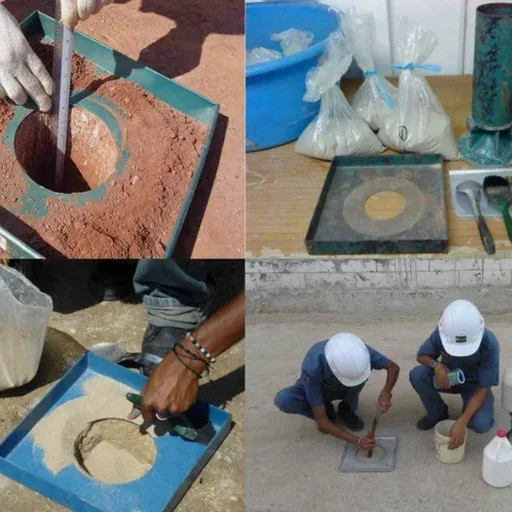
Site-specific factors
The Piedmont's saprolitic soils create a unique risk profile for compaction work around Raleigh. This material weathers in place from granitic or metamorphic bedrock, preserving a relict structure that can fool the eye. A lift compacted to 98% of standard Proctor in the morning can drop below 92% if a summer thunderstorm rolls through before the next lift is placed. Undetected low-density zones in utility trench backfill are particularly dangerous—they invite differential settlement that cracks pavements and racks door frames within the first two years. ASTM D1556 requires a minimum of one test per 1,500 square feet of lift, but we recommend a tighter spacing on commercial pads and anywhere fill exceeds four feet in thickness. The other quiet risk is operator error: a sloppy hole, contaminated calibration sand, or a poorly trimmed baseplate edge can bias the density reading by several percentage points. Our field crew carries NIST-traceable scales and replaces calibration sand every 20 tests to maintain accuracy across the 5 to 10 pcf range that separates a pass from a fail.
Video overview
Reference standards
ASTM D1556, ASTM D1557, AASHTO T 191, ASTM D2216
Complementary services
Nuclear Gauge Testing
ASTM D6938 compliant testing for larger sites where rapid, non-destructive readings across a grid are required. We hold a North Carolina Radiation Protection Section license.
Laboratory Proctor Curves
Modified and standard Proctor testing (ASTM D1557 / D698) on your borrow source or site soil to establish the target density benchmark before field work begins.
Proof Rolling Observation
Visual observation of subgrade response under loaded dump trucks or rollers, combined with spot density tests to identify soft zones before placing aggregate base.
Typical parameters
Common questions
How much does a sand cone density test cost in Raleigh?
A single field density test using the sand cone method typically falls between US$100 and US$160 per point, depending on the number of tests and travel distance within Wake County. A full-day rate for continuous compaction control on larger sites may offer better value.
How deep can the sand cone test go?
The sand cone method is designed for shallow lifts, usually 6 to 8 inches thick. That's the typical compaction lift thickness for engineered fill. If you need density information at greater depths, we recommend combining it with CPT probing or a test pit to sample deeper zones.
What percentage of compaction does the City of Raleigh require?
City of Raleigh and NCDOT specifications generally require 95% of maximum dry density per the modified Proctor test (ASTM D1557) for structural fill under pavements and footings. Utility trench backfill may have a slightly lower standard, but 95% is the safe benchmark for most commercial work here. More info.